 Continue with Facebook
 Continue with Google
 Continue with Apple
ENCOUNTER: Music for Here and Now
Details
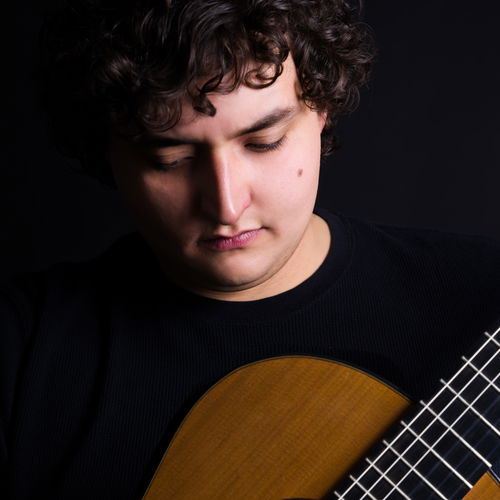
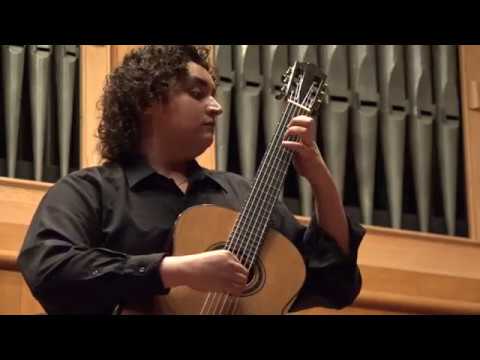
Fred Springer full profile / Solo Classical Guitar / 1 musician
Full program notes
Capricho Catalan, op. 165, no. 5
Isaac Albeniz is perhaps the most celebrated Spanish piano composer of the late nineteenth century. He spent time at the Paris Conservatoire learning from musicians like Gabriel Faure, then went on to be the main teacher of Spanish composers including Enrique Granados, helping establish key elements of the Spanish Impressionist style. He wrote many pieces drawing on Spanish tradition, location, and character: Espana, where we find this ‘Capricho Catalan’; Suite Espanola no. 1 & 2, the first being incredibly popular among guitarists (more so than pianists); and Iberia which represents a major work in piano literature and was praised by the likes of Debussy and Messiaen. The piece you hear tonight is an angelic tune from the region of Catalonia, Spain, home to the province of Girona where Albeniz was born. The arrangement I play is by David Russell, with a few additional notes from the original piano score.
Variazioni e Fuga, op. 95
Mario Castelnuovo-Tedesco was an Italian composer and pianist who fled to the United States during the outbreak of World War II. He composed music for over a hundred Hollywood films, mostly with MGM (receiving no screen credit for almost all of them). Before leaving Europe, he met Andres Segovia who encouraged him to compose for the guitar, leading to one of the most significant bodies of work of any twentieth century guitar composer. One of his early works was the masterful Sonata (Omaggio a Boccherini), after another prolific Italian composer, premiered in Geneva by Segovia. A music critic for the Journal de Genève, Mr. J. Guilloux, wrote a review saying that the piece was nice, but Segovia was such an artist that even if he played J’ai Du Bon Tabac (a French nursery rhyme) it would be magnificent. Tedesco, taking this as an affront on his composition, asked Segovia to get the music for this silly song from the critic. The work presented here is the result of this exchange, almost certainly composed by Tedesco in a single afternoon. It is a satirical set of variations on the tune he received.
The piece’s sections are marked as follows: Introduction (sneezing), Theme (grumpy and jerky), Variation I (vivid and light/fat and vain), Variation II (plaintive and monotonous), Variation III (a l’espagnole, Hommage a Granados), Variation IV (Romantic Interlude), and Variation V (L’inevitable Fugue). All the titles and musical markings are written in French (the critic’s native tongue), including many that are certainly more than musical markings like the reference to sneezing and the “fanfaron”, or “braggart”, marking in the second variation. The piece is playful, like Mozart’s variations on Ah, je vous dirai, maman! which the composer admits was on his mind at the time of writing. It is full of elements that demonstrate his intellect and wit, with a direct reference in the Hommage to Granados to that composer’s fourth Danza Espanola whose melody has an overlap with a fragment of the nursery rhyme, one of the most substantial fugues written for the guitar, and a scale just before the end marked “without rigor, almost a cadenza.” Castelnuovo-Tedesco sent and dedicated the piece Mr. Guilloux.
The Bungalows
Dr. Razvan Bezna is a Romanian-Canadian guitarist and composer. We met at the University of Texas at Austin, where we were the only two guitar performance majors in our class; we studied together and played chamber music as the NWSE Duo and in the University of Texas Guitar Quartet. Dr. Bezna started composing during our time in Austin: I saw many of his compositions come together from improvised fragments that he would adjust and add to until a piece revealed itself. During our last year, as we were preparing for a time of great change, this piece was written. It has a foreboding sense of melancholy and nostalgia which speaks to the time of transition we both faced, preparing to graduate and move to new places and programs. The title refers to the name of the apartment complex where Dr. Bezna lived for two years, and I moved in as his neighbor our last year. It contains a small musical quote from Debussy’s ‘Clair de Lune’ which we were studying at the time. As neighbors, we would spend hours practicing for upcoming recitals, working on papers, and playing music together. This musical souvenir is a window into the past, and the composer wrote it with the dedication “to my friend Fred Springer.”
Alfonsina y el Mar
This is a song I heard before I was born, one my mother grew up listening to. Ariel Ramirez is one of the most famous composers from Argentina, and his music has a national importance with themes of indigenous people from the Andes, liberation for oppressed people all over the country, and historicization of various Argentinian political, social, and artistic figures. Alfonsina Storni was a poet who lived from 1892-1938 and became a sort of folk-hero after her death. The story goes that she walked into the sea in Mar del Plata right after sending her last poem (Voy a dormir.../I am going to sleep...) to a newspaper. This story, along with her body of work and position as one of the first Argentinian women to gain respect and acclaim in a male dominated field, inspired Ramirez to write the song Alfonsina y el mar (Alfonsina and the sea). It is now one of the most famous songs from Argentina, recorded and championed by Mercedes Sosa. It was her recordings I heard from the womb, and her recordings I listened to when developing the piece. The arrangement is by Jorge Cardoso, an Argentinian guitarist and composer.
Three Bardenklange, from op. 13
Johann Kaspar Mertz was a revolutionary guitar composer. Born in modern day Slovakia, he was fully immersed in the Austro-Hungarian empire and eventually toured across Europe playing concerts. He is one of the first guitarists to mention the use of nails of the right hand for plucking the strings and to put into practice many of the ideas or techniques that were only theories before. As a composer, his music has a distinctly romantic character, displaying an affinity for bel canto, opera fantasies, and, above all, character pieces. With the Bardenklange, op. 13, he is comparable to Schumann and his Papillon, op. 2 or Carnaval, op. 9. These collections of short character pieces are emblematic of the Romantic era, and Mertz was one of the first guitarists to display true artistry in composing larger sets of these types of pieces. With didacticism seemingly the furthest thing from his mind, expression stands as the driving force behind these beautiful miniatures.
The ‘Romanze’ opens the first book of Bardenklange (Bardic Sounds). The harp-like introduction gives way to a bel canto melody, and the piece is full of Mertz’s impressive use of different musical textures on the guitar. ‘An Malvina’ (to Malvina) is the second piece in the collection, and its title suggests it may have been written with a certain special someone in mind. Again, we hear expert deployment of the idiosyncrasies of the guitar to achieve different textures, this time fluttering arpeggios which accompany the bel canto melody. The last piece in this set, ‘Tarantelle’, comes from the sixth book of the collection. This fiery dance is a genre unto itself, reframed here as less the dance of a spider and more the death dance of someone bitten by a spider. A rondo form is used to showcase different episodes where we recall memories like smelling the first good flower of spring, only to return to the present whirlwind of frenzy. Many of the pieces from Bardenklange were recorded by my former mentor, Adam Holzman, and I studied some of these pieces with him. Now whenever I play guitar, especially Mertz, I am inspired by memories of hearing Holzman play or talk about music.
Suite del Recuerdo
Jose Luis Merlin is an Argentinian guitarist and composer who has written many works for guitar. None more famous, however, than the Suite del Recuerdo. This collection of pieces is based on traditional dances and characters found in Argentina and surrounding areas. The suite is dedicated to Atahualpa Yupanqui, a famed Argentinian guitarist and singer who died in 1992, who championed indigenous music and culture and wrote songs that became synonymous with Argentinian folk music. This suite is heavily reminiscent of Argentinian folk music, ripe with dance rhythms, soulful melodies, and energetic episodes. The opening Evocacion returns just before the end of the whole suite, inviting us to recollect ourselves before joining the brighter ‘Joropo’ which brings the work to a close.
The composer said this about the piece: "This is an homage to memories, my memories. To the collective memories of my people living in nostalgia, tormented, anguished, happy and hopeful. Memories from the country, in San Luis, with all the smells and sounds from the country. It is like looking inside yourself in very profound silence. Memories of afternoons with grandparents, aunts and uncles, parents, brothers, sisters, cousins. All enjoying each other, sharing our feelings and playing guitar, sitting in the back yard drinking wine, under the vines. Lots of them are not here anymore. They are in my memories."
Historical context
This program has a place in many historical contexts. The variety of times and places where this music originated points to universal themes that connect with us in the here and now. As a classical guitarist, many of the influences come from or evoke Spain and its traditions. My maternal ancestry is Argentinian, partly Spanish, so music from Spain and Argentina are featured in the program. As a classical guitarist, our repertoire is also relatively finite, so there are a few pieces that I "grew up with" in a sense, listening and loving them from my earliest days with the instrument.
I consider it very special to be able to share all of the music on the program with audiences, and I love to speak about the pieces live to offer a more grounded connection and enliven the experience for all of us.
Videos from this player

Audio from this player
Other programs from this ensemble
- Musician profile: Fred Springer
-
 Instruments:
Soprano, Baritone, Guitar, Piano
Instruments:
Soprano, Baritone, Guitar, Piano
- Musicians: Fred Springer, Kendra Comstock, Nathan Halbur, Ben Yee-Paulson
-
- Musician profile: Fred Springer
-
Instruments:
Flute and Guitar
- Musicians: Fred Springer, Díjí Kay